Ippo Ippo, step by step
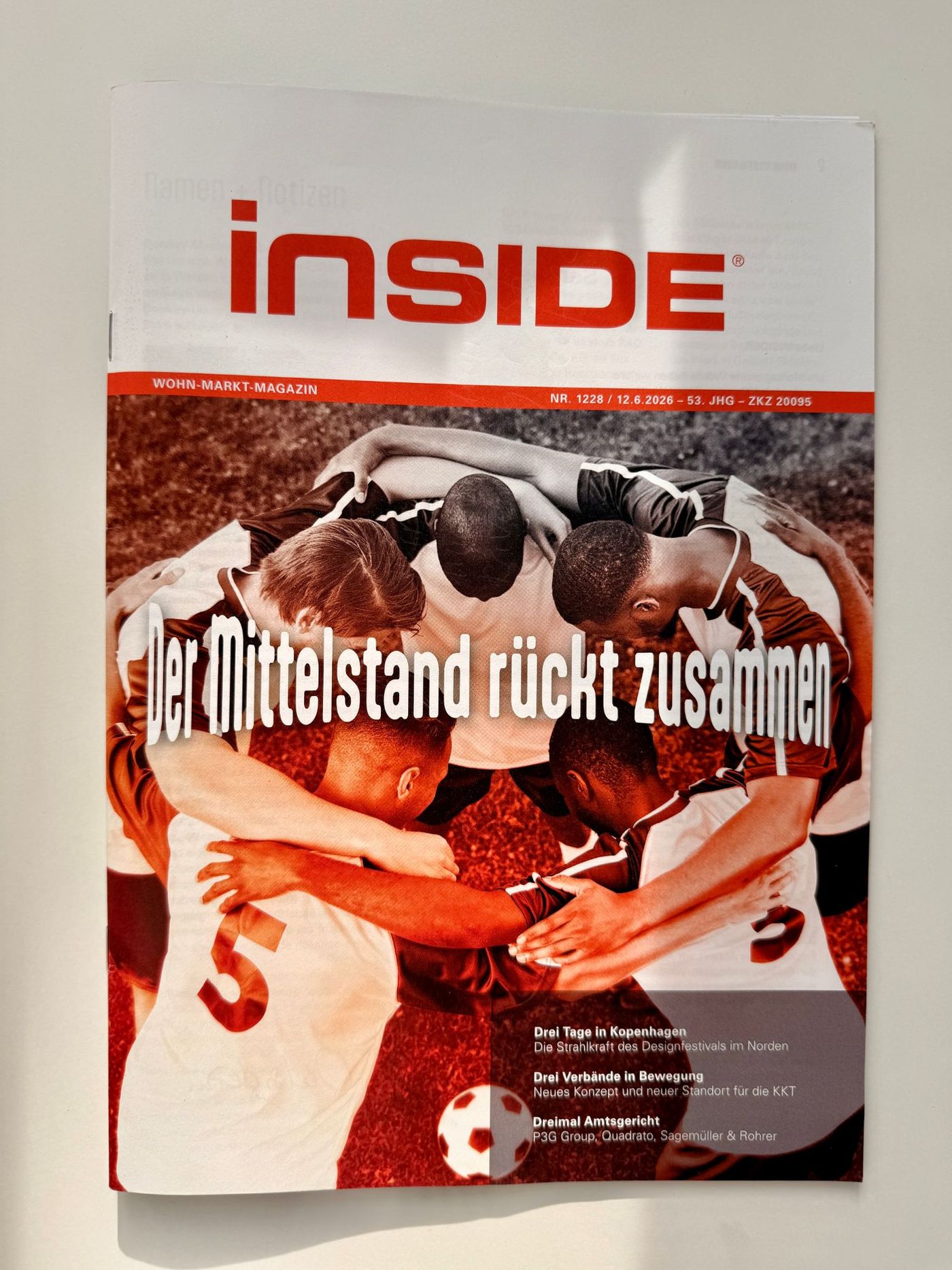
Guest article in INSIDE Wohn-Markt-Magazin, No. 1228, 12 June 2026
INSIDE is the trade magazine of the German furniture and interior industry. For its June issue, I wrote about the first three years of 2nd home: why we started a marketplace for second-hand furniture, why the furniture industry does not have a technology problem but a structure problem, and why rejections became fuel.
Read the announcement at INSIDE Wohnen (German)
Read the article in English
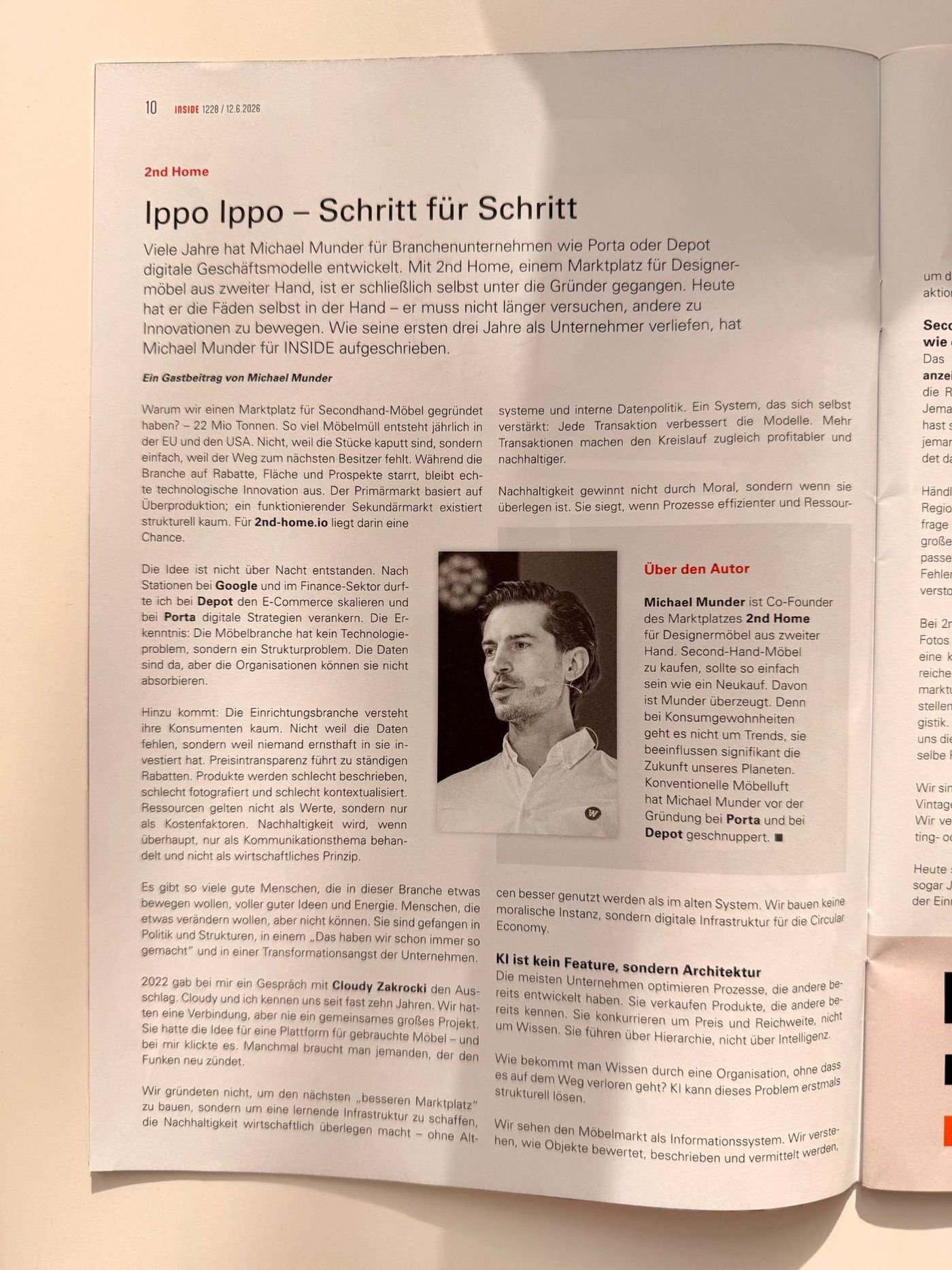
For many years, Michael Munder developed digital business models for industry players such as Porta and DEPOT. With 2nd home, a marketplace for pre-owned designer furniture, he finally became a founder himself. Today he holds the reins and no longer has to persuade others to innovate. For INSIDE, he wrote about his first three years as an entrepreneur.
Why did we start a marketplace for second-hand furniture? 22 million tonnes. That is how much furniture waste the EU and the US produce every year. Not because the pieces are broken, but because the way to the next owner is missing. While the industry stares at discounts, retail space and brochures, real technological innovation fails to happen. The primary market is built on overproduction; a functioning secondary market barely exists. For 2nd-home.io, that is an opportunity.
The idea did not come overnight. After roles at Google and in finance, I scaled e-commerce at DEPOT and anchored digital strategies at Porta. The insight: the furniture industry does not have a technology problem, it has a structure problem. The data is there, but the organisations cannot absorb it.
On top of that, the home furnishings industry barely understands its customers. Not because the data is missing, but because nobody has seriously invested in it. Price opacity leads to constant discounting. Products are poorly described, poorly photographed and poorly put into context. Resources are treated not as assets but only as costs. Sustainability, if at all, is treated as a communication topic, not as an economic principle.
There are so many good people in this industry who want to move things forward, full of good ideas and energy. People who want to change things but cannot. They are trapped in politics and structures, in a "we have always done it this way" and in companies' fear of transformation.
In 2022, a conversation with Cloudy Zakrocki tipped the balance. Cloudy and I have known each other for almost ten years. We had a connection, but never a big project together. She had the idea for a platform for used furniture, and it clicked for me. Sometimes you need someone to rekindle the spark.
We did not found the company to build the next "better marketplace", but to create a learning infrastructure that makes sustainability economically superior, without legacy systems and internal data politics. A self-reinforcing system: every transaction improves the models. More transactions make the cycle more profitable and more sustainable at the same time.
Sustainability does not win through morality, but when it is superior. It wins when processes are more efficient and resources are used better than in the old system. We are not building a moral authority, but digital infrastructure for the circular economy.
AI is not a feature, it is architecture
Most companies optimise processes that others have already developed. They sell products that others already know. They compete on price and reach, not on knowledge. They lead through hierarchy, not through intelligence.
How do you move knowledge through an organisation without it getting lost along the way? For the first time, AI can solve this problem structurally.
We see the furniture market as an information system. We understand how objects are valued, described and brokered on their way to a new owner. Every transaction deepens this knowledge.
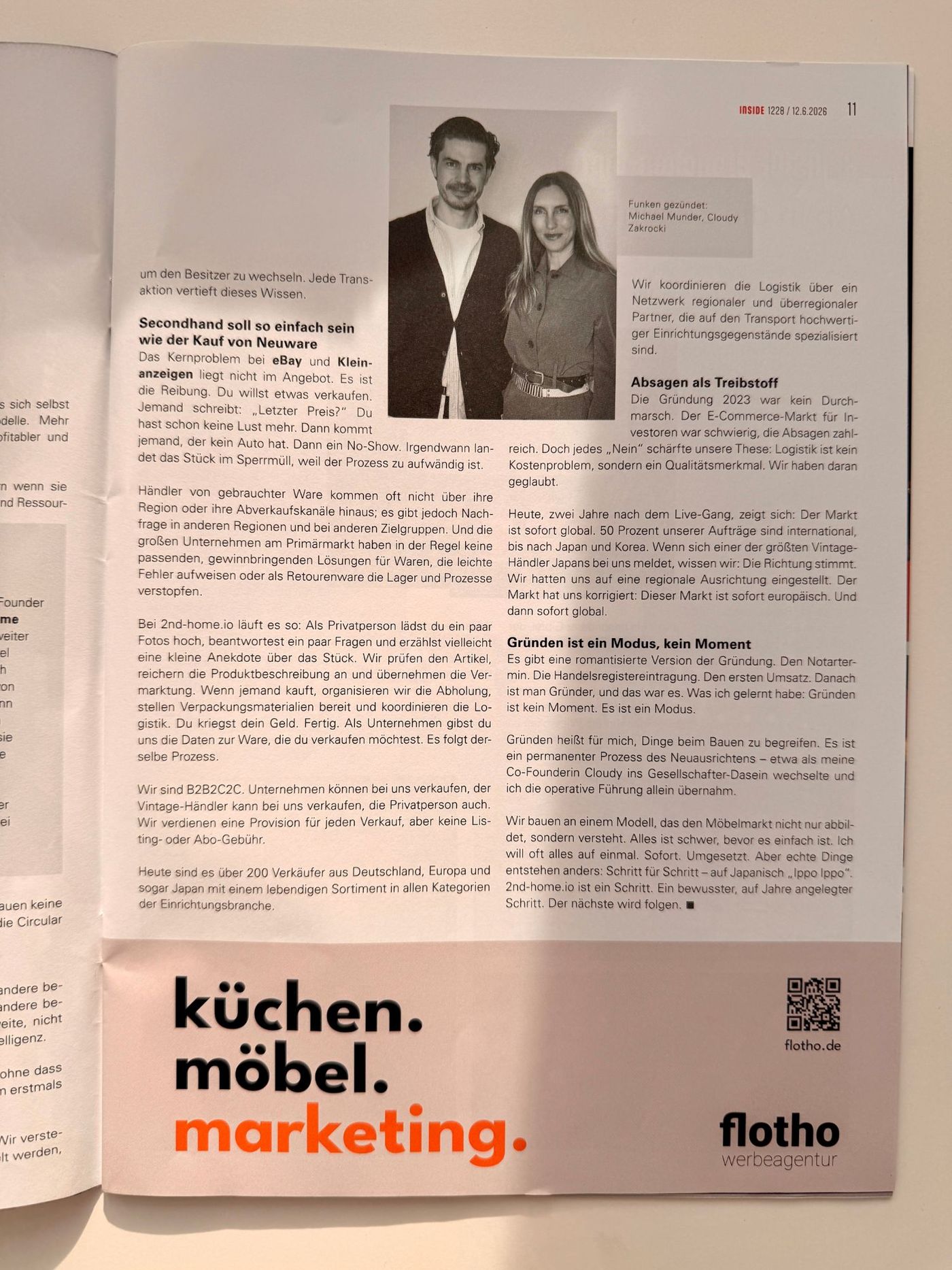
Buying second-hand should be as easy as buying new
The core problem with eBay and Kleinanzeigen is not the supply. It is the friction. You want to sell something. Someone writes: "Lowest price?" You have already lost interest. Then someone shows up without a car. Then a no-show. At some point the piece ends up as bulky waste, because the process is too much effort.
Dealers of used goods often do not get beyond their region or their sales channels, yet there is demand in other regions and among other audiences. And the big companies in the primary market usually have no suitable, profitable solutions for goods with minor defects or for returns that clog warehouses and processes.
At 2nd-home.io it works like this: as a private seller, you upload a few photos, answer a few questions and maybe share a short story about the piece. We check the item, enrich the product description and take care of the marketing. When someone buys, we organise the pickup, provide packaging material and coordinate the logistics. You get your money. Done. As a business, you give us the data on the goods you want to sell. The same process follows.
We are B2B2C2C. Companies can sell with us, the vintage dealer can sell with us, and so can private individuals. We earn a commission on every sale, but charge no listing or subscription fee.
Today there are more than 200 sellers from Germany, Europe and even Japan, with a lively assortment across every category of home furnishings.
We coordinate logistics through a network of regional and national partners who specialise in transporting high-quality home furnishings.
Rejections as fuel
Founding the company in 2023 was no walk in the park. The e-commerce market was a hard sell for investors, and the rejections were many. But every "no" sharpened our thesis: logistics is not a cost problem, it is a mark of quality. We believed in it.
Today, two years after going live, it is clear: this market is global from the start. 50 percent of our orders are international, all the way to Japan and Korea. When one of the largest vintage dealers in Japan gets in touch, we know the direction is right. We had prepared for a regional focus. The market corrected us: this market is European from the start. And then immediately global.
Founding is a mode, not a moment
There is a romanticised version of founding. The notary appointment. The entry in the commercial register. The first revenue. After that you are a founder, and that is it. What I have learned: founding is not a moment. It is a mode.
For me, founding means understanding things by building them. It is a permanent process of realigning, for example when my co-founder Cloudy moved into the role of shareholder and I took over operational leadership alone.
We are building a model that does not just map the furniture market, but understands it. Everything is hard before it is easy. I often want everything at once. Immediately. Done. But real things come about differently: step by step, in Japanese "Ippo Ippo". 2nd-home.io is one step. A deliberate step, planned for years. The next one will follow.
Thank you to Simon Feldmer, Eva Charlotte Ernst and the team at INSIDE Wohnen Verlags GmbH for the platform and for permission to show the pages here.